Living with agoraphobia: an immersion essay

Time is a curious archivist. As I sort through the fragments of my writing journey — essays, stories, and reflections from my Literature degree in 2018 — I find myself face-to-face with earlier versions of myself. This immersion essay emerged during that formative period, capturing a raw confrontation with anxiety that still resonates today. While my approach to pacing and tone has evolved since then, there’s something authentic here I’ve tried to preserve. Perhaps in honoring the writer I was, I better understand the writer I’ve become. degree in 2018
There’s a tingling in my fingers and it’s not from the alcohol. I don’t belong on this dance floor and these kids know it. What do most people do when they find themselves in the middle of a herd of sweaty, cocksure teenagers? If I were their age I suppose I’d go with it — throw my head back and just be. But I’m not their age. I’m not even from the same galaxy. They tower over me — a different species — as if those born after 2000 were endowed with superhuman height.
Must be the millennial bug.
There’s the familiar stench of body odor and frothing hormones that conjure memories: the late-90s, football halls crammed with staggering, sloshing teens bobbing their heads to Foo Fighters. But now… here… I’m an imposter. My breathing is unsteady, my heart throbs at a staccato, racing to match the pulse of the music.
Become the pulse, feel the music… I tell myself.
The music surges skyward and I wish I were lifting with it — up and away. But instead I am shrinking, certain that some unseen, enormous hand is closing in — fingers splayed, ready to smother me.
I watch as one of the male teens pirouettes into my space — not before glancing down to check if I’m real. He’s been baptized with Hollywood looks, flamboyantly confident and comfortable in his own skin. He wears a polyester blue shirt fastened with bubblegum braces and his hair’s a shock of wax chocolate.
There’s an amused expression plastered across his face, as if studying an oddity — a man out of time. And in a way I am— in my mid-thirties, sure. But I’m a time traveler.
The young man cranes his neck. From this close I can see a hint of mascara and glitter peppered across his right cheek. Then quite suddenly, he contorts his face and gyrates around me — striking ostrich poses, his neck doing things my arms could only attempt. Ignore the cartoon, I tell myself. Ignore the dread — the true provocateur — but it’s too late, fear is out of its cage.
I close my eyes.
The night had been a series of false starts. Tom had the idea we do a pub crawl. “Let’s gargle down some single malt, roam the streets like escaped mental patients,” he joked.
I hadn’t seen Tom in years, but he was still the same: half philosopher, half writer. He still had the same parted fringe and rocked that odd goatee. Still deceptively abstemious and reserved — yet his boyish, near impish quality had not waned. After warming up with several pints in a comfy bar called Hell’s Kitchen (a name that begged foreshadowing) we continued on to what Tom referred to as “The Badlands.” We strolled up and down King Street in the spitting rain, my hair falling wet and flat across my face, water dripping from my nose.
On our first attempt to enter a nightclub (a place called Brown Alley) we were greeted by stony glares and folded arms. A big guy dressed all in black approached me, asked if we were on the guest list, to which we replied a blatant no. Then we were informed that we were in the wrong line. “This line is for a private function. General entry is in that line,” he said, pointing to the line opposite. We course corrected and were immediately gobbled up by a crowd of teens and twenty-somethings. Upon reaching the roped entrance we were scanned by yet another ominous sentry. “Not you two,” he said in a low muscular drawl.
I stood my ground. “Why not us?”
He gestured for us to leave the line. “You’re not on the guest list.”
Clearly a blatant lie.
“Well… how do we get on the guest list?” I asked, some edge in my tone.
“Invite only. You need to book, gotta be V.I.P,” he said.
I am very important I wanted to declare, but instead I came back with something even more antagonizing.
“Is this because we’re not sixteen?”
All at once we found ourselves surrounded by three immovable slabs of meat. The one I was failing to parlay with told us to step out of the line, said something about us causing a scene — and I thought it was just simple discourse. Then I uttered a word that really stirred the broth: discrimination. He thrust his chest out like a gorilla marking his turf. I could almost smell the testosterone in the air — a mix of wet asphalt and pepper. “Whatcha gonna do mate, call the police? Go ahead call ’em, see if they fuckin’ care,” he barked.
I never mentioned police or intended provocation. I didn’t realize a simple conversation could evoke such hostility. I also never asked to be dragged into a back alley, howling and kicking like a fresh catch. I never asked to be beaten and tossed to the curb, the rain washing away the blood from my pummeled face, Tom desperately wiping the spit from his phone to dial an ambulance — at least that’s what was playing through my mind as Tom tugged at my arm and said: “Let’s go, let’s just go.”
I suppose it was a trigger, the cocking of a gun, before we would even reach a bar. For someone already anxious, that kind of hostility can send you spiraling into fight-or-flight mode. My body tensed, my breathing shallow, as adrenaline flooded my system — priming me for dangers that existed only in my mind. The crowded street suddenly felt like a gauntlet I had to survive rather than a simple walk between venues.
Every club after this was a similar experience (though not as hostile as Brown Alley). It was as if all the bouncers along King Street had texted through the same codes: birthday event, private function, V.I.P function, guest list, invite only. Finally one bouncer shot us a look of both pity and sympathy and suggested The Waterside Hotel — told us it doubled as a nightclub for all ages. I gave him an equivocal glare and he shot me a look that said: Yes, even social outcasts can get in. Our destination was secured.
Fear is like an old friend, just one you don’t invite to parties. Fear is not a singular sensory experience, like a pain receptor in your finger — rather, it’s ubiquitous, like a brain full of insects; a head full of ants that devour everything in sight.
My eyes are still closed, but I’m experiencing what can only be described as sleep paralysis — a suffocation that arises from the invasion of one’s personal space. The only difference is, I’m awake.
In moments such as these I try to imagine holiday destinations like Thailand: basking under the balmy weather, sipping on a cocktail — but it doesn’t work. You see, When I open my eyes I’m sure everyone will be glaring at me — their hands covering their mouths, arms akimbo, shaking their heads, gasping and muttering words like: unbelievable, embarrassing, pathetic. So I don’t open them, not yet.
Maybe I can navigate my way to the bar, like a blind person… feeling my way through the fear.
When you have agoraphobia one thing quickly becomes apparent: you need people to be far away from you or the entire universe will collapse in on itself — your own personal Big Bang.
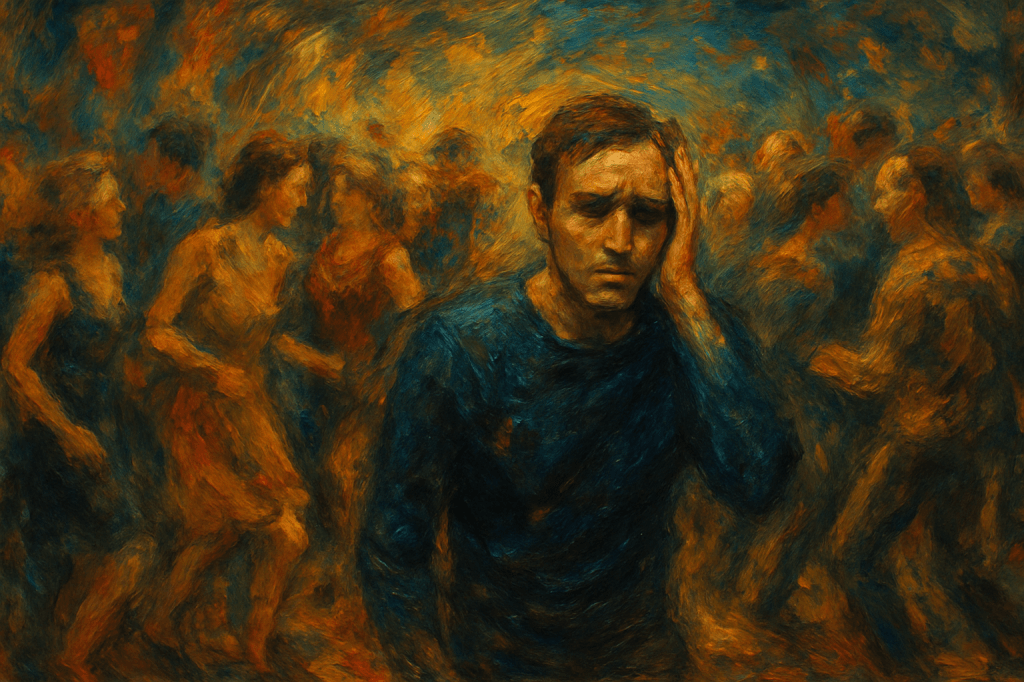
I recall the day I had my first panic attack…
I was in my early twenties and was riding a bus to the city. It was nothing out of the ordinary. I was just watching the passing scenery in a trance, like washing in a dryer — when all at once something felt wrong. It started as a gnawing in my stomach, my throat felt parched and narrow and the space around me — the meters, centimeters, millimeters — began to compress and I found myself caught between a pair of shoulder pads and a stranger’s armpit.
Only then did the fear arrive.
First, a stirring in the blood. Then, a series of short shallow breaths. Until finally, my heart wound up to a gallop and complete panic took control.
Then came my screams: “Stop the bus, stop the bus!”
Passengers gawked at me, spoke words I couldn’t make out as I barged through them, my only thought being: Where the hell is the exit… I need air. The bus finally stopped and I stumbled off gasping for breath, clutching at my chest in the middle of some unfamiliar suburb.
I saw a doctor shortly after my first attack. He handed me some pamphlets and instructed me to try some breathing exercises — said it might help reduce the likelihood of another panic attack, but there was no guarantee.
Is there ever?
I wanted to know how it all began, how I’d become frightened of the mundane, terrified of everyday people.
He informed me that each phobia was unique and triggered by some latent indelible fear.
“When you were a child did your mother ever abandon you?” he asked.
“No, of course not.”
And then I remembered how my stepdad once, by mistake, put me on the wrong bus. Instead of arriving safely at school, I endured a solitary journey through the urban sprawl of Perth. I was only eight years old then, far too timid to approach strangers — so timid, in fact, that I never even tried to ask for help. Instead, I wandered the city alone until a group of people found me sobbing, crouched on the ground, and called the police.
I never told the doctor that story. I don’t know why. Perhaps I didn’t want to believe that my panic attacks truly stemmed from childhood. It just seemed too obvious, so ridiculously Freudian or something. Or maybe I wasn’t ready to acknowledge how that single event — being lost and alone as a child — could shape my adult reality so profoundly.
He said something like: “Try to avoid busy crowds, things that might spike your anxiety.”
Nowadays they tell you to face your fears, they call it exposure — people who confront their phobias one step at a time. But even the most sensitive person can have trouble crossing an intersection.
When I open my eyes I’m immediately greeted by a young woman’s glare. She has blonde hair that falls straight to her shoulders and is dressed in what can only be described as a black faux-leather onesie — she’s just missing the devil horns. Nonetheless, she studies me like some dizzy marsupial before twirling around so her back’s facing me. It’s subtle — but clearly a rejection. I don’t blame her. I’ve made several disco faux pas since being here.
It’s no wonder.
I have no dance floor etiquette and move like some dysfunctional automaton — scissor hands slicing at the air, yet somehow barely kinetic. I’m the non-collectable action figure left in the center of the room that nobody wants to play with. And now the sweat is pouring from me and I’m afraid it will cause some hipster to slip and smash their iPhone screen. There’s that word again, afraid.
Suddenly, a girl in a wine-colored smock crashes into the back of me. “Sorry, man… you OK?”
She winks and laughs, her eyes gleaming. Then she raises her arms, twisting them playfully like two pythons, her gaze locked on mine, a grin spreading across her face. She’s the kind of girl I might chat up in a parallel dimension — but in this one, I just feel displaced.
I try to tell myself: this is just anxiety, just chemicals in my brain. But my thoughts race with catastrophic possibilities. My pulse quickens as I struggle to regulate my breathing. Inhale for four, hold for seven, exhale for eight. Inhale for four, hold for seven… My fingertips begin to tingle, that familiar rush of pins and needles — the harbinger of panic.

Perhaps it’s the presence of the girl — her devil-may-care smile, the way she shakes her head as if to say: You really need to relax, dude. And so I try. I slow my breathing, and soon I feel something shift… my brain begins to slow. Now I can actually hear the music: the wobble of the bass, the thud of the beat rippling through my bones.
I’m still in the wrong place — a man out of time, out of his depths — and so what? As soon as we’re born, we’re out of our depths, doggie-paddling toward the inevitable.
But I didn’t come here just to test my limits — I came here to face my social anxiety, to see if I had what it takes to reclaim my freedom. And what does it take? Surely we must reach a point where fear no longer governs our lives — where panic attacks and agoraphobia no longer take precedence over our right to simply exist.
Perhaps this is the true face of fear: that we never really graduate into the confident, untroubled people we imagine others to be.
I relax; our bodies pulse closer. The girl grins at me, nodding, moving. We’re all on the dance floor, and nobody really has the perfect move, or nonpareil fashion sense, or a first-class face. Nobody is ever the prime version of acceptable.
I’m hit with a single truth: fear is universal — but so is courage. Every person on this dance floor knows some version of anxiety: the moment before stepping into the light, the hesitation before speaking, the quiet worry about belonging. We’re all constantly navigating invisible thresholds between comfort and growth.
What separates us isn’t age or confidence, but simply our willingness to step across those thresholds — even as our hearts race.
There’s a place beyond the fear — where the very act of being alive is ample enough reason to careen through a crowd or catch public transport. We each have a need to belong, but that inclusion has to begin with a little raw exposure. In fact, facing your fears may be a prerequisite for living a long and healthy life.
I smile back at the girl in the red smock. Sometimes, a small connection is enough to remind us: we’re of the same stock… the same species, after all.
I place a finger over my wrist and count my pulse.
I’m fine.
I’m better than fine.
And the fear? Maybe it’s jumped on the wrong bus and is heading out of town. At least for the moment.
Agoraphobia is an anxiety disorder characterized by fear and avoidance of places or situations that might cause panic, helplessness, or embarrassment. It often develops after one or more panic attacks, creating a cycle of avoidance behavior that can significantly impact a person’s quality of life.
 Jakob Ryce