Young Adult fiction, inherited systems, and the moment we begin to see the machinery
It has been nearly ten years since I last wrote seriously about Young Adult fiction.
Back in 2017, while completing my literature degree, I wrote an essay called The Mirror of Young Adult Fiction. At the time, I was interested in the way literature written for young people reflects the social and emotional pressures of adolescence: identity, alienation, independence, family, sexuality, fear, belonging, and the sometimes painful discovery that the world is considerably more complicated than childhood led us to believe.
I was interested for another reason too: I had begun writing a Young Adult novel of my own. That novel has survived, although almost nothing else about it has remained untouched. Nearly a decade later, I am approaching the end of it, and returning to my old essay has made me think again about something I only partly understood when I first wrote it: why does Young Adult fiction work so extraordinarily well with dystopia?
The relationship is so familiar now that it can almost seem inevitable: a young protagonist, an oppressive society, forbidden knowledge, a government, corporation, institution or ideology determining how people are permitted to live, and somewhere inside it all, a teenager beginning to ask questions. But there is a reason those ingredients fit together so naturally, and to understand it, it’s worth going back a little.
By the late 1960s, books such as S. E. Hinton’s The Outsiders were showing what the category could become. Hinton gave young readers a window into the hardened life of social outcasts through an adolescent voice that still feels startlingly immediate, dealing with class, masculinity, violence, loyalty and alienation without treating its teenage characters as children merely waiting for adulthood to make them interesting. That distinction matters: Young Adult literature gradually became a place where adolescence could be treated not merely as preparation for adult life, but as a meaningful state of existence in its own right.
Over the decades that followed, the genre became increasingly willing to confront mature subjects: love, betrayal, sexuality, violence, addiction, abuse, poverty, death, political power and despair. Each generation, in its own time, could look toward Young Adult literature as a mirror of its anxieties and aspirations. And eventually, that mirror became dystopian.
When the Machinery Becomes Visible
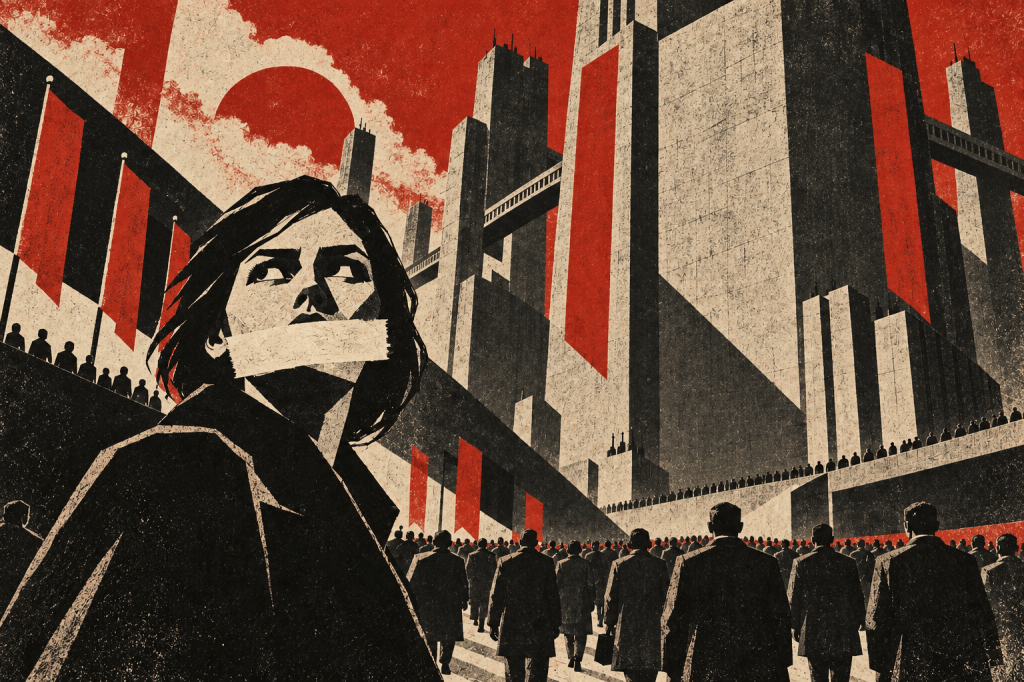
Perhaps that was inevitable. There is something about adolescence that seems almost designed for dystopian fiction. As children, most of us inherit the world largely unquestioningly: family, school, government, religion, class, money, law, gender, work. The structures already exist when we arrive, and we learn their rules long before we are capable of asking who created them. Adolescence changes that, and soon enough the machinery begins to become visible. Rules suddenly have authors. Institutions have histories. Parents can be wrong. Governments can lie. Laws can be unjust. Wealth is not distributed fairly. And authority is not synonymous with wisdom.
For perhaps the first time, a young person begins to understand that the world they inherited was built by other people, shaped by competing interests, compromises and structures of power. And once a protagonist begins asking why the world has been organised this way, dystopia is never very far behind.
Suzanne Collins’s The Hunger Games remains perhaps the clearest modern example of why this marriage works. Katniss Everdeen is thrust into adulthood by circumstance long before she enters the arena. With her father dead and her mother incapacitated by depression, Katniss is left to provide for her younger sister Prim and effectively becomes the family’s protector. She is still a child, but childhood has ceased to be available to her.
We see versions of this outside fiction all the time: the teenage child who becomes a caregiver, the older sibling who effectively parents younger children, the adolescent who assumes adult responsibility after divorce, illness, addiction, poverty or family collapse. Katniss’s resentment toward her mother therefore reads as more than ordinary teenage anger. It becomes displaced fury at helplessness itself: at poverty, at a resigned district, at a social hierarchy in which some people have the luxury of falling apart while others simply have to keep their family alive.
Her home life has already taught her something the Games will later make brutally explicit:
Childhood is not equally distributed. Some children are allowed to remain children. Others are made useful. And some are simply dispensable.
This is one reason Katniss works so well as a Young Adult protagonist. The Capitol does not introduce her to powerlessness; it merely formalises it. Before entering the arena, she is already hunting illegally to keep her family alive, concealing what she thinks, and learning which emotions are safe to display and which must remain hidden. By the time she becomes a political symbol, she has been shaped by systems she never chose and responsibilities she never asked for.
Her politics emerge gradually. She does not begin as a revolutionary with a manifesto; she begins as someone trying to survive, and becomes the reluctant heroine the districts had been waiting for, and the political threat Snow had been trying to prevent. But the Capitol turns survival into spectacle. The Games are not merely punishment; they are theatre. Children are selected, dressed, interviewed, assessed, televised and killed in front of an audience, so that government violence becomes entertainment, and entertainment becomes an instrument of government.
The individual is turned into spectacle.
That is one version of Young Adult dystopia, and its descendants are everywhere. James Dashner’s The Maze Runner places adolescents inside an environment whose rules they do not understand, strips them of memory, and makes knowledge itself something that must be recovered. Neal Shusterman’s Unwind makes the relationship between youth and systemic power even more grotesquely literal, allowing teenagers to be legally dismantled, their bodies redistributed under a social arrangement that insists they have not technically been killed. Different stories, different mechanisms, but the same underlying horror: adults have designed the system, and young people must live inside its consequences.
Dystopia Has More Than One Face
Dystopia obviously does not belong exclusively to Young Adult fiction, and stepping outside the category for a moment helps explain why the form fits adolescence so well regardless.
Another novel I’ve taught my students is Yoko Ogawa’s The Memory Police, first published in Japan in 1994, which approaches oppression very differently from Collins. Ogawa has spoken about the image of Anne Frank writing while hidden and confined as an influence on the novel: the preservation of an interior world while an external power attempts to control the conditions of existence.
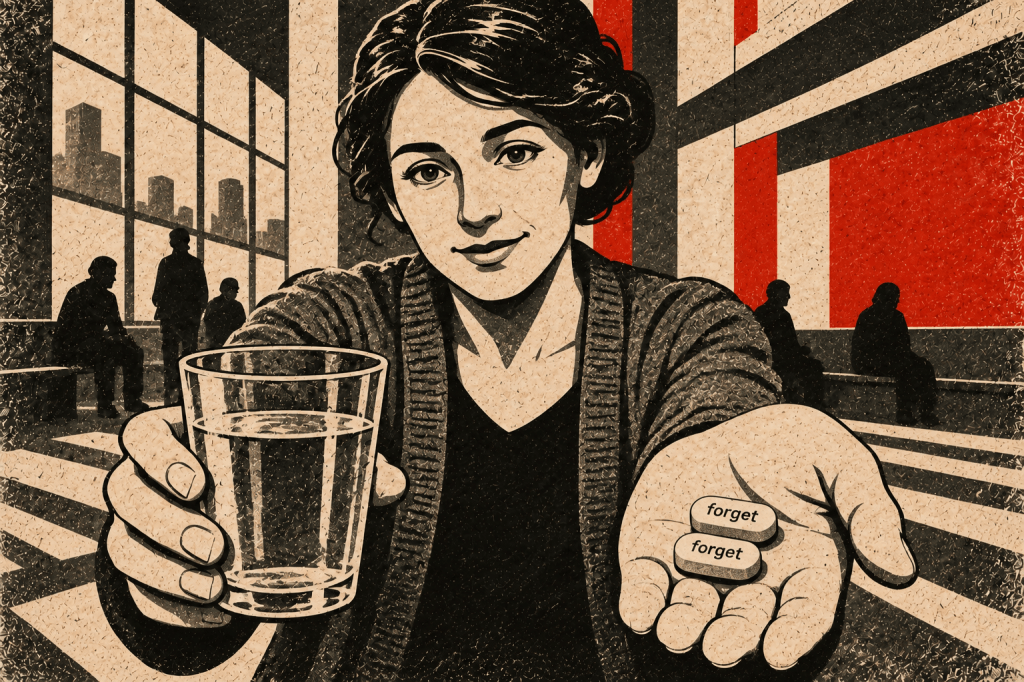
In The Memory Police, repression works through disappearance. Objects begin to vanish from an unnamed island, first ordinary things and then others, and only a few people ever think to ask questions. But the inhabitants lose more than the objects themselves; most gradually lose their emotional connection to whatever has disappeared, so that memory follows the object into absence. A disappearance therefore takes something larger with it: association, history, family, identity.
The horror is not simply that the Memory Police enforce these disappearances. It is that eventually people stop missing what has been taken. There is no grand uprising in The Memory Police. Ogawa is not interested in placing her narrator on a hilltop with a fist raised, rallying a young army into revolution. Her story is quieter. Its question is not primarily how we overthrow the system, but what happens when the system succeeds so completely that we begin to forget why resistance mattered in the first place.
What The Memory Police understands, I think, is that repression doesn’t always look like soldiers at the door, or a voice booming from behind a painting, or a cage of rats strapped to someone’s face. Sometimes it looks like slow erosion. Sometimes it is simply bureaucratic or psychological, so gradual that people barely notice what has been removed until the absence itself becomes ordinary.
It is difficult to read The Memory Police without thinking of George Orwell’s Nineteen Eighty-Four. Both novels understand that political control becomes vastly more powerful when it reaches beyond public behaviour and into memory itself, and both recognise that whoever controls the past possesses extraordinary power over the present. But they approach that idea differently.
Orwell gives us the Ministry of Truth, where history is continually rewritten until the official record becomes whatever the Party requires it to have always been; a government that demands that two plus two equals five. It’s pure control for control’s sake. Ogawa gives us disappearances and asks what happens when you can no longer remember what numbers were for.
Before becoming George Orwell, Eric Blair spent five years serving in the Indian Imperial Police in Burma. He had been part of the machinery, and that is not incidental. Orwell had occupied a position inside a system capable of humiliating, coercing and controlling other human beings, and what he experienced there did not stay neatly contained in Burma. It followed him into his political imagination.
Writers carry those experiences forward, especially the ones involving powerlessness. But a system does not need to be totalitarian to make an individual feel powerless. It can be economic, administrative, algorithmic; it can operate through policy, eligibility, wealth or simple scarcity. Sometimes nobody personally decides to remove you at all; a collection of rules, prices and circumstances merely converges until there is no longer a place for you.
Once you have experienced that kind of marginalisation, it becomes difficult not to notice systems. Perhaps inevitably, they have found their way into my fiction.
Kazuo Ishiguro’s Never Let Me Go approaches systemic power from yet another direction. It is not a Young Adult novel, although its early sections follow young characters through childhood and adolescence.
Its characters are not primarily trained to resist the society that defines their lives; they are trained to accept it. That is what makes the novel so disturbing.
They grow up inside a structure that has already determined what their bodies are for, and the system does not require constant theatrical violence because its assumptions have already been normalised. There is no Capitol waiting to be overthrown, just a society that has learned how to make exploitation look reasonable. They have nothing left to rebel against but their own conditioning.
The Systems We Inherit
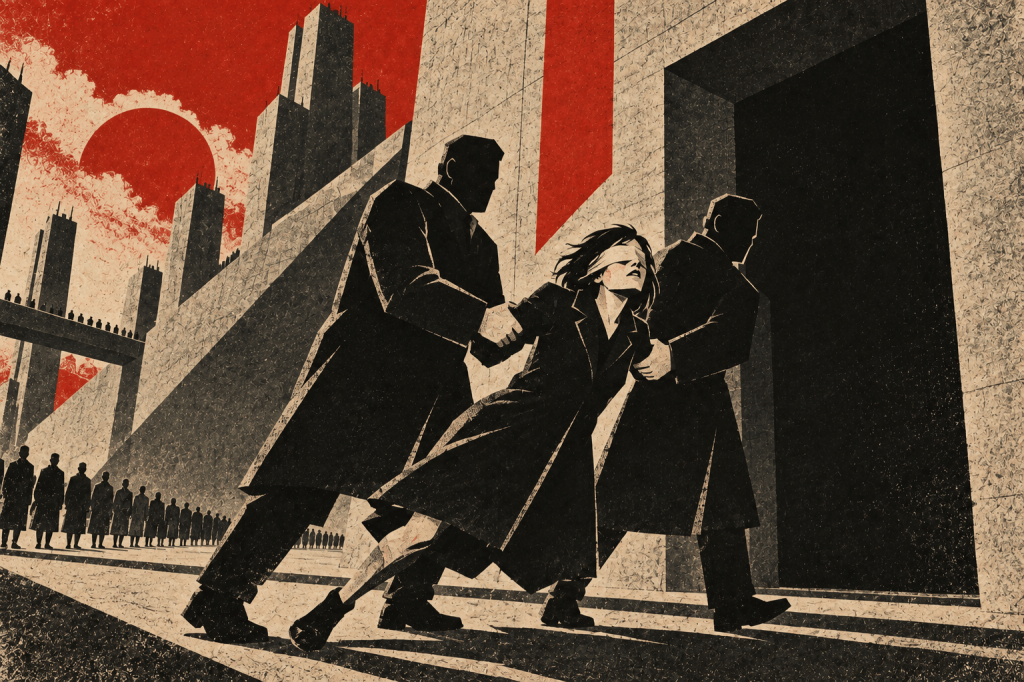
Put these four traditions beside one another and dystopian power begins to look less like a single structure and more like a collection of methods: Collins gives us oppression through spectacle and fear; Ogawa gives us oppression through erasure; Orwell gives us coercion through surveillance and the manipulation of truth; Ishiguro gives us oppression through normalisation.
The system does not always arrive wearing a uniform. Sometimes it arrives as policy, and at other times it presents itself as technology, tradition or care. Occasionally it arrives as a set of assumptions so deeply embedded in society that nobody remembers when they began.
This is where I find myself returning to Young Adult fiction, because who is better placed to encounter those systems for the first time than someone standing on the edge of adulthood? The adolescent protagonist occupies a peculiar position: old enough to understand that something may be wrong, but often not yet settled into the compromises, adaptations and assumptions through which adults learn to live with it.
While teaching English to final-year high school students, I sometimes ask what they want to study at university, and most of the time I’m met with “engineering, or something like that,” even from students who are clearly talented at music, art or filmmaking, the kinds of pursuits society has already quietly decided not to take seriously as careers. The cynicism is already there. They can see the hypocrisy in it without yet having learned to call that hypocrisy pragmatism.
They can recognise injustice without automatically assuming it is inevitable. And crucially, they inherit systems they had absolutely no part in designing. That is the situation Katniss finds herself in, or Thomas in The Maze Runner, or the teenagers marked for unwinding in Shusterman’s world. They did not build these societies. They simply woke up inside them.
Perhaps that is why dystopia belongs so naturally to the young. Teenagers aren’t uniquely rebellious, and the genre was never theirs alone. But adolescence is one of the first moments in life when resistance becomes something we can consciously understand: not simply refusing a rule, but beginning to question who made it, why it exists, and who it serves.
Part of my continuing fascination with this comes from teaching teenagers, though much of what I teach isn’t Young Adult literature at all. At the moment I have students working through Pat Barker’s Regeneration, yet the questions that arise are remarkably similar:
What happens when an institution fails somebody?
What does it demand from a person in exchange for belonging?
When should someone obey, and when should they refuse?
Watching young readers wrestle with those questions has probably taught me as much about Young Adult fiction as reading books marketed as YA ever could. And perhaps it is one reason I have continued writing within the genre myself.
The novel I began almost ten years ago, and am now finally close to finishing, contains some of the familiar architecture of Young Adult dystopia: systems, institutions, secrecy, power, and young people attempting to understand a world shaped long before they entered it. I will write separately about what all those years of working on that novel have taught me, because that is another story entirely.
But one thing has changed. I am far less interested now in simple tyrannies. I am more interested in systems that become dangerous through compromise, fear, ambition, good intentions, bureaucracy and ordinary human failure. The world is rarely divided neatly between heroic rebels and people twirling moustaches behind a bank of monitors. Sometimes catastrophe emerges because people make reasonable choices without understanding what those choices will eventually become.
When I first wrote my degree essay, The Mirror of Young Adult Fiction, in 2017, I thought the defining movement of dystopian YA was often from oppression toward liberation. Nearly ten years later, I am no longer sure that is the most interesting way to look at it. Perhaps the deeper movement is from innocence toward comprehension.
Childhood asks us to accept the world. Adulthood asks us to participate in it. Adolescence sits uneasily between the two, at the moment when we begin to realise that the world we have inherited was built by other people, according to rules we never agreed to.
And perhaps that is why Young Adult fiction returns so often to rebellion, memory, surveillance, belonging and identity. Childhood allows us to imagine that the world still contains some hidden magic. Adolescence is often the moment that illusion begins to fall away. What replaces it is something harder: systems, consequences, compromise, and the unsettling discovery that the world was built by people no wiser than we are.


Leave a Reply