On shame, comparison, and just doing the work

A new book arrives in my inbox from an author whose name I only half recognize. At some point I must have downloaded a sample, or bought the book outright for a dollar, and that one small decision signed me up for something that is both admirable and frustrating.
Since then the emails arrive every couple of months like clockwork. A cold blue cover. A woman’s face in shadow. Ninety-nine cents, read free with Kindle Unlimited.
And it’s not just random strangers. A good friend of mine publishes a novel every six weeks. Full stop. He’s one of the kindest men I know, and I mean that completely. But something about the pace of it has bothered me for years, and I’ve never quite known how to say that without sounding bitter. Some of that bitterness is real. Some of it, I suspect, is about me.
Just Write
Long before I knew anyone could actually write that fast, one of my literature professors asked if I’d finished my poetry manuscript yet. I told her I was still “piecing it together.” She rolled her eyes and sighed, one of those long sighs that lands more like a scolding than disappointment.
“Just write,” she said. “Don’t try to perfect it. Just get it out.”
It wasn’t the first time I’d evaded her, or changed the subject, or found some reason the work wasn’t ready yet. The talent was there in the writing, she had explained, that’s what made it so frustrating: watching me set a project down and walk away, over and over.
Back then, during my lit degree, I kept starting things. A novel, then another, then a book of poems, each one abandoned somewhere past the opening chapters. But credit where it’s due, I guess: I published my first book of poetry in 2021, and I wrote a hundred thousand words of a sprawling speculative-fiction novel around the same time. It eventually lost its way entirely, and years later I tore it apart and rebuilt it from the ground up after a workshop that changed how I thought about character for good.
That novel is close to finished now, and I’ve even started another one that’s moving much faster. But that’s a story for another time.
I’ve always thought of a novel as closer to a confession than a product. A place a writer leaves behind whatever they actually believe about the world, buried deep enough in plot and character that it doesn’t read like a lecture. That’s the tradition I studied. It’s the bar I hold my own work to, for better or worse.
Genre fiction often comes with a structure that’s already been tested for decades. A crime thriller has a shape you can lean on. A political thriller has one too, and there’s nothing lesser about using it well. Speculative fiction, especially the kind interested in invented power structures, in what it means to be cast as the other inside a constructed society, doesn’t have that scaffold. You have to build the mechanics of the world before you can even find out what the story is actually trying to say through them.
My own dystopian series has been cooking, to steal Atwood’s expression, for ten years. It wasn’t until I understood what the book actually was, underneath the plot, that I could start rewriting it properly.
And yet the newer novel I’m working on now has no invented society to build from scratch, and it’s moving fast. Once I understood the premise, the characters started pulling the story forward on their own, and at this rate I’ll likely finish it in a couple of months. So it isn’t that I’m simply a slow writer. Some stories need years to find their shape. Others don’t.
The rub remains, though: why some writers can turn out a new novel every six or eight weeks, and I need years for mine.
So I decided to actually look at how the writers I admire work instead of sitting with the feeling.
How They Actually Work
Anthony Trollope timed himself to two hundred and fifty words every fifteen minutes, three hours a day, watch open on the desk. He held down a full-time job at the post office the entire time, commuting constantly, and still treated those three hours like a second job with its own fixed clock-in. When he finished a novel with time left on the watch, he wrote “The End,” pulled out a fresh sheet, and started the next one before lunch. Forty-seven novels in thirty-eight years.
James Patterson has kept up something close to Trollope’s pace in the present day; since his first novel in 1976, he’s averaged a new release every six weeks. But his method is different in a way that matters: he outlines the book in detail, a co-author writes the draft from that outline, and Patterson edits the result for voice. Stephen King once called him, bluntly, “a terrible writer.” Patterson’s answer to that kind of criticism has never been about money. “My time here is short,” he’s said. “What can I do most beautifully?”
And speak of the devil:
Stephen King writes two thousand words a day, every day, including holidays. But the number is only half the method. He calls adverbs his mortal enemy, and in his craft book On Writing, compares an unchecked adverb to a single dandelion on a lawn: harmless-looking at first, then five the next day, then the whole lawn has turned to weeds before you’ve noticed. A high school teacher once handed back one of his stories with a single note: “Not bad, but PUFFY.” He’s spent the decades since editing like he never wants to see that word again, and now aims to cut roughly a tenth of every manuscript once the draft is done.
Haruki Murakami runs a routine nearly as rigid as King’s. When he’s writing a novel he’s up at four in the morning, at his desk for five or six hours, then out for a ten-kilometre run or a swim, the same schedule held for months without a single day off. He’s compared the whole thing to survival training, the discipline of the body making the discipline of the page possible. But the number that actually matters isn’t the four a.m. start. A first draft takes him roughly six months. Then he spends another seven or eight revising it, running the manuscript through nine or ten total passes before he’s done. The routine is similar to Trollope’s rigor; the revision is nearly as long as the writing itself.
Margaret Atwood works nothing like any of them.
She doesn’t outline. She’s described her process as jumping in, the way you’d jump into water, and lets scenes arrive out of order, trusting they’ll find their place later. She once wrote two sections of a novel five years apart, because the book, in her own words, simply wasn’t ready yet.
It was still cooking.
The Part That Belongs to Me
Most of my anger at fast writers is anger at myself: the grey now showing at my temples, and a book I started so long ago I can barely remember who I was when I began it. There’s a voice that tells me I’ve run out of the kind of time patience requires, that the writers moving fast are simply better at spending what’s left of theirs.
But I think it’s closer to self-esteem than time. Part of why any of us procrastinate is fear, the fear that the work goes out into the world and gets met with a shrug. Unfinished, it stays brilliant in our own heads, safe in a folder, in the cloud, wherever we’ve hidden it. There’s no risk with that.
But risk, I’m starting to understand, is the actual game.
While I may not truly appreciate the factory line style of writing a book every six weeks, I admire the courage. Patterson said it plainly when someone pushed him on the pace: “My time here is short. What can I do most beautifully?” Life is short, and if you don’t do the work, there’s nothing to show for it.
No chapters. No pages. No progress.
And that kind of regret can eat you alive.
But also, what I’ve come to learn is: nobody actually writes 90,000 words. They write the scene in front of them over and over again.
I learned that myself earlier this year in Vietnam, when teaching and writing were the only two things on my plate. I wrote three chapters of my young adult dystopian novel a week, and they were good chapters. I just wrote what was in front of me and didn’t think about anything else, or the entire mountain ahead. It took ten years to find the shape of that book before I could even restart it properly. It took far less time once I actually knew the story, knew what the characters wanted, and found a planning process that worked for me.
And planning properly is its own entire article for another time.
Years ago, during my degree, I wrote an analysis about a short story that stopped me cold. It had the kind of quiet, devastating control over emotion most writers spend a lifetime reaching for. The writer eventually wrote back to me, thanking me for my feedback and analysis. I’ve watched for a novel from him ever since. It’s never come. I don’t know why, and it isn’t my place to guess, but it’s stayed with me as its own kind of warning: talent alone doesn’t finish anything.
Sometimes the very carefulness I’ve been defending in this essay is what buries a book instead of saving it.
But by the same token, sometimes the slow way is the best approach for some writers.
Ursula Le Guin wrote the fourth Earthsea book, Tehanu, almost twenty years after the first three. It came from a writer who’d lived an entire life in the gap between them, and most people who love that series will tell you it’s the deepest one, the one where the characters finally feel their age instead of just their plot function.
Kazuo Ishiguro’s case gets under my skin more. He started taking notes for what became Never Let Me Go in 1990, filed under the working title “The Students’ Novel.” He abandoned it. He picked it up again in 1995. He then abandoned it a second time, wrote two entirely different novels in the years between, and only came back to finish it properly after those were done. It was published in 2005. Fifteen years between the first note and the finished book, and somewhere in that decade and a half it became one of his most acclaimed novels.
In 2015, long after she’d said she was done writing novels at all, Le Guin spent a session online answering strangers’ questions about craft. One of them was forty-three, just starting his first serious project, convinced he’d already left it too late. She told him plainly that he hadn’t. Prose, she said, is the art that develops slowest. Then she pointed him toward José Saramago, whose major novels arrived only after he turned sixty.
The Work Is the Work
I still can’t write a novel in six weeks. I don’t want to. That’s a process for other writers, and some of them see it as a production line and do it well, churning out books faster than someone might mow their lawn. Maybe there’s pride in stacking up the numbers. Maybe it’s just financial survival, especially for independent writers whose living depends on steady Amazon sales. Who am I to call that the lowest common denominator, when I haven’t even finished a novel myself?
I can’t judge work I haven’t read. And I can’t judge from where I’m sitting either, still wrestling with my own demons, procrastination, my own inconsistency, and the parts of this that no one can really teach you. Recognising our own limitations is a personal discovery, one we have to make for ourselves, but it can’t stay just an observation if it’s actually inhibiting the work. It’s a case of recognition and action.
What I’ve landed on is trying to build a routine that’s consistent without breaking me, one that survives the curveballs life throws at it. Because sometimes a project comes to a halt, and it isn’t the writer’s fault at all. Sometimes it’s just the ordinary demands of getting through another day, stealing the one thing every writer actually needs.
Time.
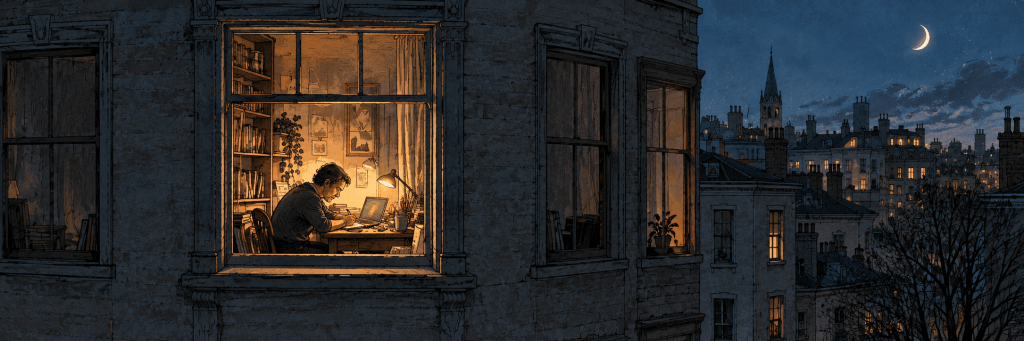
Writing a novel is one of the most unglamorous, quietly isolating things you can do. You look like a recluse, people want to read it before it’s finished (so for the love of God, don’t tell them), and you have no idea how readers are going to respond, whether an agent will pick it up, whether you’ll get it published, or whether you’ll end up self-publishing.
I don’t think this was ever really about fast writers. I think they were a mirror, and what I saw in it stung more than I wanted to admit. Someone with fifty-seven books, and I haven’t finished my first. That’s not envy exactly, it’s more like shame, and shame is dangerous precisely because of what it quietly does to you. Sit with it too long and it can start to work on you: freeze your progress, and one day you wake up and stop opening the document instead of finishing it.
What I actually needed to learn had nothing to do with speed. It was consistency, a habit that gets you back to the page on the days you don’t want to be there, and the discipline to write badly rather than not write at all. My old professor’s advice echoes now more than ever: just write, don’t try to perfect it, just get it out.
Comparing myself to anyone else’s output is never going to get the words down. Only showing up does, page after unglamorous page, whether the work that day was good or not. As long as each chapter follows the beat map I’ve already sketched out, and the characters stay true to who they are, then even a rough chapter is okay, because it’s true. I’ve gotten less precious about a first pass, less convinced every sentence has to arrive finished.
So when my friend announces another book, six weeks after the last one, I still feel that old flicker. It’s quieter now, though, and it isn’t really about him anymore, I just listen to a different voice now: “Stop thinking and just write the next damn chapter, Jakob.”


Leave a Reply